


Quick answer
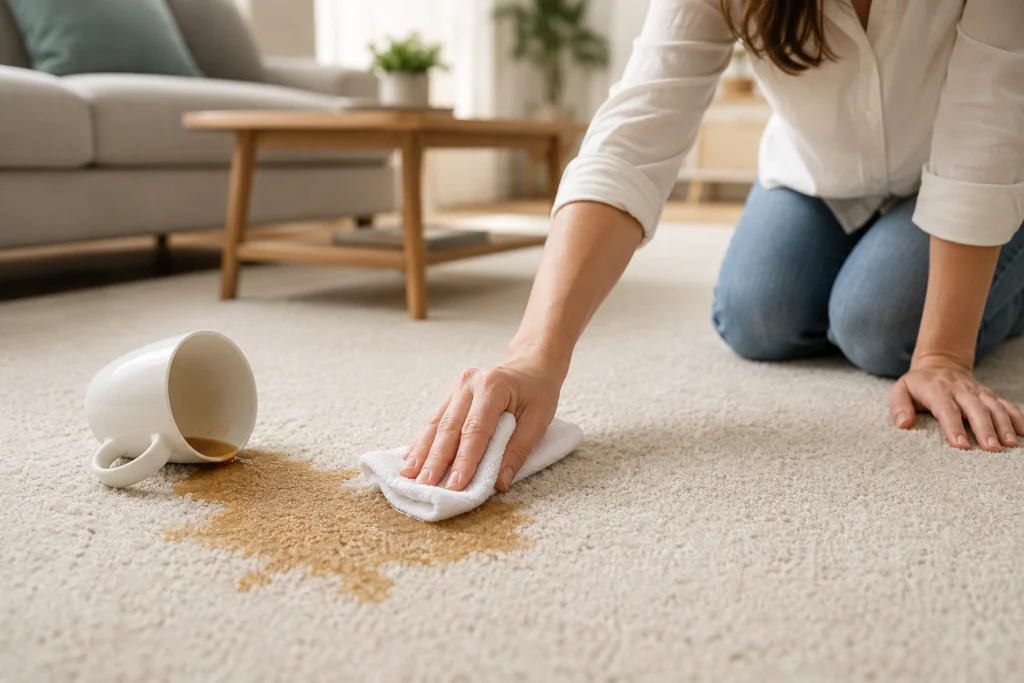
If you spill something on your carpet, act quickly but avoid scrubbing. Remove any solid material carefully, then blot liquids with a clean white absorbent cloth, working from the outside of the spill towards the centre.
The biggest mistake is often trying too many cleaning products too quickly. Strong stain removers, bleach, excessive detergent or repeated soaking can turn a treatable spill into permanent colour or fibre damage, particularly on wool and other sensitive carpets.
If you are unsure what the carpet is made from or the mark is not improving, it is usually safer to stop and have the area professionally assessed.
What Should You Do Immediately After a Carpet Spill?
The first few minutes matter because the longer a liquid remains in the carpet, the further it may penetrate into the pile and potentially towards the backing underneath.
Start by removing anything sitting on the surface. If food, mud or another solid substance has fallen onto the carpet, lift it carefully with a spoon or another blunt-edged object. Avoid pressing it into the fibres.
For liquid spills, use a clean white cloth or absorbent kitchen paper and blot the area gently. Apply enough pressure to absorb the moisture but do not rub backwards and forwards.
Continue using a fresh part of the cloth until very little liquid is transferring from the carpet.
Working from the outside of the affected area towards the centre can help prevent the spill from spreading.
Why Should You Blot a Carpet Instead of Scrubbing It?
Scrubbing often feels like the natural thing to do because we associate vigorous rubbing with cleaning. On carpet, it can easily make the problem worse.
Rubbing can spread the contamination over a larger area and work it further into the pile. It may also affect the appearance of the fibres, particularly on more delicate carpets.
On wool, aggressive rubbing can disturb the fibre surface and leave the treated area looking different from the surrounding carpet even if the original stain improves.
Blotting is slower, but it allows you to remove moisture and contamination without unnecessarily working it deeper into the carpet.
If you have a wool or wool-rich carpet, our guide to wool carpet cleaning explains why fibre type, pH and agitation all need to be considered carefully.
Should You Put Water on a Carpet Spill?
A small amount of appropriate treatment can sometimes be useful, but flooding a carpet with water is rarely a good first response.
Adding too much moisture may spread the contamination, move it further into the carpet or increase the amount of water that needs to be extracted and dried afterwards.
This is particularly important if you are using a small domestic or hire machine. Putting more water into the carpet does not automatically mean better cleaning if the equipment cannot recover that moisture effectively.
Our guide comparing truck-mounted carpet cleaning with hire machines explains why extraction power and moisture recovery matter just as much as solution flow.
Should You Use Washing-Up Liquid or Household Cleaner?
Be cautious.
One of the most common DIY approaches is to mix washing-up liquid or another household cleaner with water and apply it to the carpet. Sometimes this appears to work initially, but it can leave detergent residue behind.
That residue may attract new soil, causing the treated patch to become dirty more quickly than the surrounding carpet.
General household products can also contain ingredients that are unsuitable for some carpet fibres or dyes.
If you use any carpet cleaning product, it should be suitable for the carpet being treated and used at the recommended dilution. More product does not mean more cleaning power.
Repeatedly adding different products to the same stain can make subsequent treatment more difficult because the cleaner is then dealing with both the original contamination and the residues left by previous attempts.
What About Supermarket Carpet Stain Removers?
Supermarket stain removers vary considerably.
Some are designed for specific types of contamination, while others contain stronger chemistry that may not be suitable for every carpet.
Oxidising products are a particular concern on some fibres and dyes. They may lighten the area rather than simply remove the original stain.
Once the carpet colour itself has been altered, the problem is no longer straightforward contamination. The stain may have been reduced, but permanent colour change can remain.
This is why it is often safer to blot a fresh spill thoroughly and seek advice before experimenting with several different products.
What Should You Do With Coffee or Tea on Carpet?
Coffee and tea can leave noticeable brown staining if they are allowed to dry.
Start by blotting up as much liquid as possible using clean white absorbent material. Continue until very little moisture or colour transfers to the cloth.
Avoid scrubbing and resist the temptation to soak the area with detergent.
Coffee containing milk can be more complicated because the spill contains both coloured liquid and protein or fat residues. If the mark remains visible after careful blotting, professional treatment may be the safer option.
The sooner the area is treated correctly, the better the chance of achieving a good result.
What Should You Do With Red Wine or Fruit Juice?
Strongly coloured drinks can penetrate carpet fibres quickly, so prompt blotting is important.
Use a clean white cloth and absorb as much liquid as possible without spreading the spill. Work gently from the outside towards the centre.
Avoid pouring large amounts of water, salt, white wine or other household remedies over the area.
Some home treatments may dilute the visible colour temporarily but create a larger wet area or leave other residues behind.
If strong colour remains after blotting, particularly on wool or a light-coloured carpet, it is worth having the stain professionally assessed.
What Should You Do With Grease or Oily Food?
Oil-based contamination behaves differently from tea, coffee or water-based drinks.
If food has been dropped, carefully remove the solids first. Then blot any remaining grease without rubbing it further into the pile.
Avoid adding large amounts of water because oil does not simply dissolve in water.
Greasy contamination often requires suitable chemistry to break it down before extraction. Using an inappropriate detergent may spread the mark or leave a sticky residue.
This is one of the situations where understanding the carpet fibre and the type of contamination becomes particularly important.
What Should You Do With Mud?
Mud can sometimes be easier to deal with once the excess has dried.
If there is a large amount of wet mud, carefully lift away what you can without pushing it further into the carpet.
Once the remaining soil has dried, vacuuming can remove a significant amount of loose particulate matter before any further treatment is considered.
Trying to scrub wet mud immediately can spread it across a much larger area.
Any remaining discolouration can then be assessed separately.
What About Pet Accidents on Carpet?
Pet urine should be dealt with quickly because the problem may extend further than the visible surface mark.
Blot up as much liquid as possible with absorbent material and avoid rubbing.
It is also best not to rely on heavily fragranced household products simply to disguise the smell. If urine has penetrated into the backing or underlay, surface cleaning may reduce the visible mark without removing the source of the odour.
Persistent or returning odours can indicate that contamination remains deeper within the carpet.
In those situations, professional carpet cleaning and targeted treatment may be needed.
What If the Spill Has Already Dried?
A dried stain is not automatically permanent.
The correct treatment will depend on what caused the mark, how long it has been present, the carpet fibre and anything that has already been applied to it.
This is why it is useful to remember what was spilled and which products, if any, you have already used.
Some stains remain as removable contamination. Others may have altered the carpet dye or fibre.
A professional cleaner can assess whether the mark is likely to respond to cleaning or whether permanent colour damage has occurred.
Why Can a Carpet Stain Come Back After Cleaning?
Sometimes a stain appears to disappear while the carpet is damp and then gradually becomes visible again as it dries.
This can happen when contamination has travelled deeper into the carpet or backing and moves back towards the surface during drying.
It can also happen when detergent residue remains behind or the carpet has been repeatedly soaked without sufficient extraction.
Adding more cleaner every time the mark reappears may make the problem worse.
Professional treatment focuses not only on what can be seen on the surface but also on removing contamination and moisture effectively.
Does Carpet Fibre Make a Difference?
Yes.
Different carpet fibres respond differently to moisture, heat, chemicals and agitation.
A polypropylene carpet, for example, may tolerate treatments that would be unsuitable for a wool-rich carpet. Even then, the backing, construction and dyes still need to be considered.
If you do not know what the carpet is made from, it is better to be cautious.
The more valuable, delicate or unfamiliar the carpet, the less sense it makes to experiment with strong chemicals.
When Should You Stop DIY Treatment?
A sensible first response is to remove the spill and blot the area carefully.
If the stain remains after that, continuing to add products is not always the best option.
It is worth seeking professional advice if the carpet is wool or otherwise delicate, the stain is strongly coloured or oily, a previous product has changed the carpet’s appearance, the affected area is large or the spill has penetrated deeply.
The same applies if you simply do not know what caused the mark.
A trained cleaner can assess the fibre, contamination and previous treatments before deciding what should happen next.
You can read more about Exact Clean’s professional training and industry background on our qualifications page.
Can Every Carpet Stain Be Removed?
No professional cleaner should promise that every stain can be completely removed.
The outcome depends on the substance involved, how long it has been present, the carpet fibre, the dyes and whether previous treatments have caused additional damage.
Some stains can be removed completely. Others may improve significantly without disappearing altogether.
Sometimes what looks like a stain is actually colour loss. In that situation, cleaning may remove any remaining contamination but cannot restore dye that has already been altered.
The earlier a fresh spill is handled correctly, the better the chances of avoiding that type of permanent damage.
What Is the Safest First Response to a Carpet Spill?
The safest approach is usually simple.
Remove solids carefully, blot liquid with clean absorbent material, avoid rubbing and do not saturate the carpet.
Then stop before the treatment becomes more complicated than the original spill.
The aim in the first few minutes is not necessarily to complete the entire stain-removal process yourself. It is to remove as much contamination as possible without causing additional damage.
Frequently Asked Questions
Should I rub a carpet stain?
No. Rubbing can spread the contamination and work it further into the carpet. Blot the affected area gently with a clean white absorbent cloth instead.
Can I use hot water on a carpet stain?
Not automatically. Heat can affect different stains and carpet fibres in different ways. Unless you know the correct treatment for the particular carpet and contamination, avoid applying very hot water.
Can I use washing-up liquid on my carpet?
It is better to use a product specifically suitable for the carpet. Washing-up liquid can leave detergent residues that attract soil if it is not thoroughly removed.
Should I use a supermarket carpet stain remover?
Only if you know it is suitable for the carpet fibre and the type of stain. Some stronger products can alter dyes or fibres, particularly on sensitive carpets.
Can an old carpet stain still be removed?
Often, yes. The result depends on the type of stain, carpet fibre, how long it has been present and anything that has already been applied to it.
Why does a stain sometimes come back after cleaning?
Contamination may remain deeper in the carpet or backing and migrate towards the surface as the carpet dries. Detergent residues and excessive moisture can also contribute to recurring marks.
When should I call a professional carpet cleaner?
Professional treatment is worth considering if the stain remains after careful blotting, the carpet is wool or delicate, the spill is strongly coloured or oily, there is a persistent odour, or previous DIY treatment has made the area worse.